
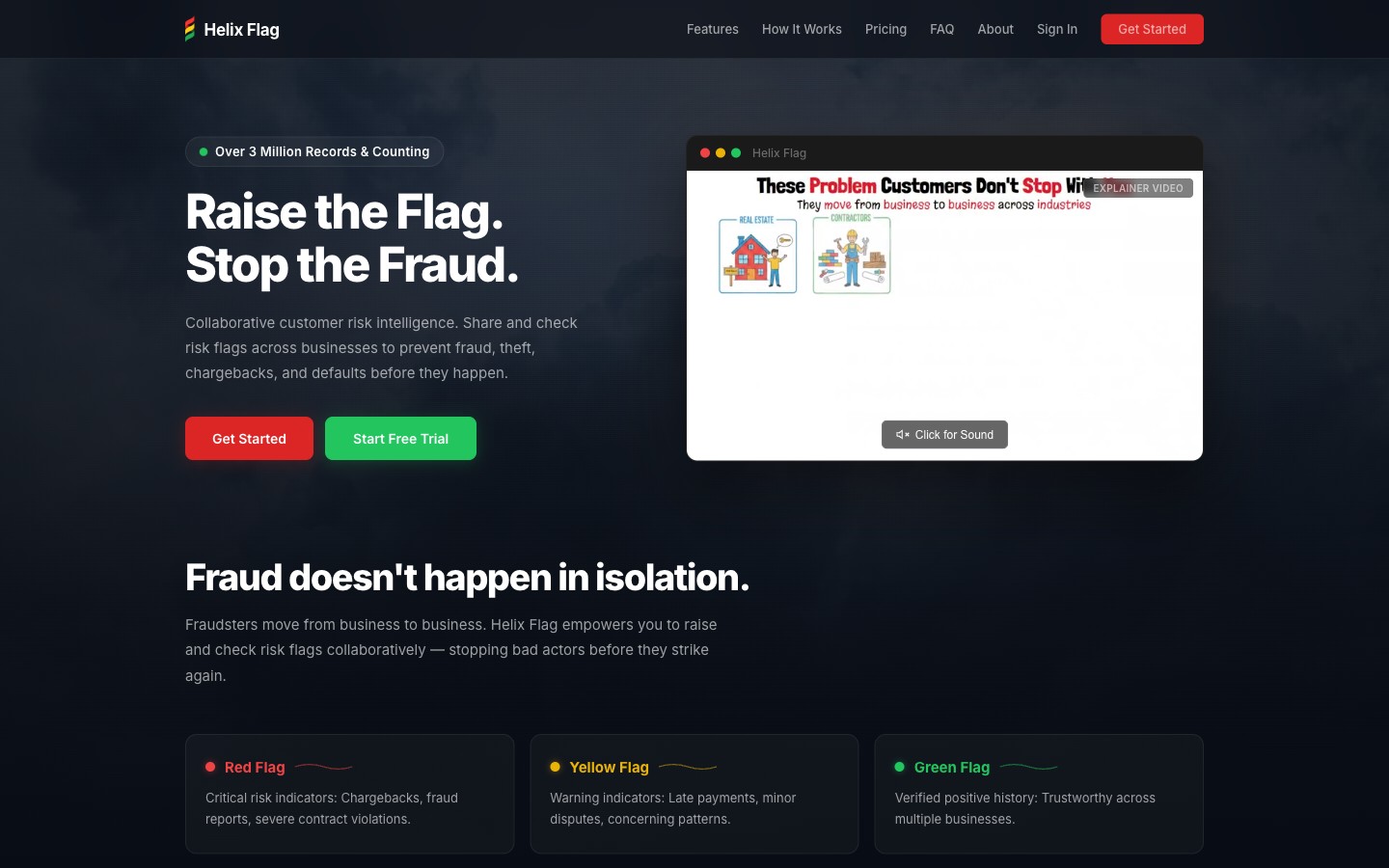
Helix Flag had traction and fragile foundations. Brigada audited it, hardened it, and turned it into a platform that ships safely — across a network of more than 3 million risk records.
What collaborative risk intelligence means
Helix Flag lets businesses raise and check customer risk flags collaboratively — chargebacks, fraud, defaults — as red, yellow, and green flags across a network of over 3 million records. The value is in the network: one business flagging a bad actor protects the next.
A risk product that disagrees with itself is worse than no risk product, because someone acts on the answer.
The problem: traction on fragile foundations
The platform worked and had customers. Underneath, it had no CI gate, schema drift between the code and the database, a signup and billing flow duplicated in five separate places, and a browser extension that could return a different verdict from the web app on the same risk check.
That last one is the dangerous kind of bug. A risk product that disagrees with itself is worse than no risk product, because someone acts on the answer.
Audit first, then systematic hardening
We ran a full audit before touching anything, then worked through it: CI hard gates so unreviewed code cannot ship, Sentry on both ends, end-to-end browser tests, and an operations runbook so the knowledge is not in one person's head.
For the risk engine specifically, golden-record regression tests — a fixed set of records with known correct verdicts that every release has to reproduce exactly.
One verdict engine, two surfaces
The extension and the web app now share a single verdict engine, so they cannot disagree. Two surfaces, one answer, by construction rather than by discipline.
The stack
Python and FastAPI on the back, React on the front, a Chrome extension alongside it, Stripe for billing, and Sentry across both ends. Brigada works in Python where the problem is data or risk, not only in Laravel.
Where it stands
Releases are gated and regression-tested, the risk engine catches duplicate-record flags it used to miss, and the team ships features instead of firefighting. Hardened by Brigada; the product is at helixflag.com.
Helix Flag — frequently asked
- What is Helix Flag?
- Helix Flag is a collaborative B2B risk intelligence platform. Businesses raise and check red, yellow, and green risk flags on customers — chargebacks, fraud, defaults — across a network of over 3 million records.
- What does platform hardening actually involve?
- On Helix Flag it meant a full audit first, then CI hard gates, Sentry on both ends, end-to-end browser tests, an operations runbook, golden-record regression tests for the risk engine, and a shared verdict engine so the browser extension and web app always agree.
- Does Brigada take over existing codebases?
- Yes. Helix Flag came to us with traction and fragile foundations. We audit first, then harden systematically, so the team can ship features instead of firefighting.
- Does Brigada work in Python?
- Yes. Helix Flag runs on Python and FastAPI with a React front end and a Chrome extension. We use Python where the work is data, risk, or AI.
- DevOps & cloudCI gates, observability, and the on-call after launch.
- AI developmentEvaluation harnesses and regression testing for systems that judge.
- IT outsourcing in KosovoTaking over an existing platform, not just greenfield builds.