
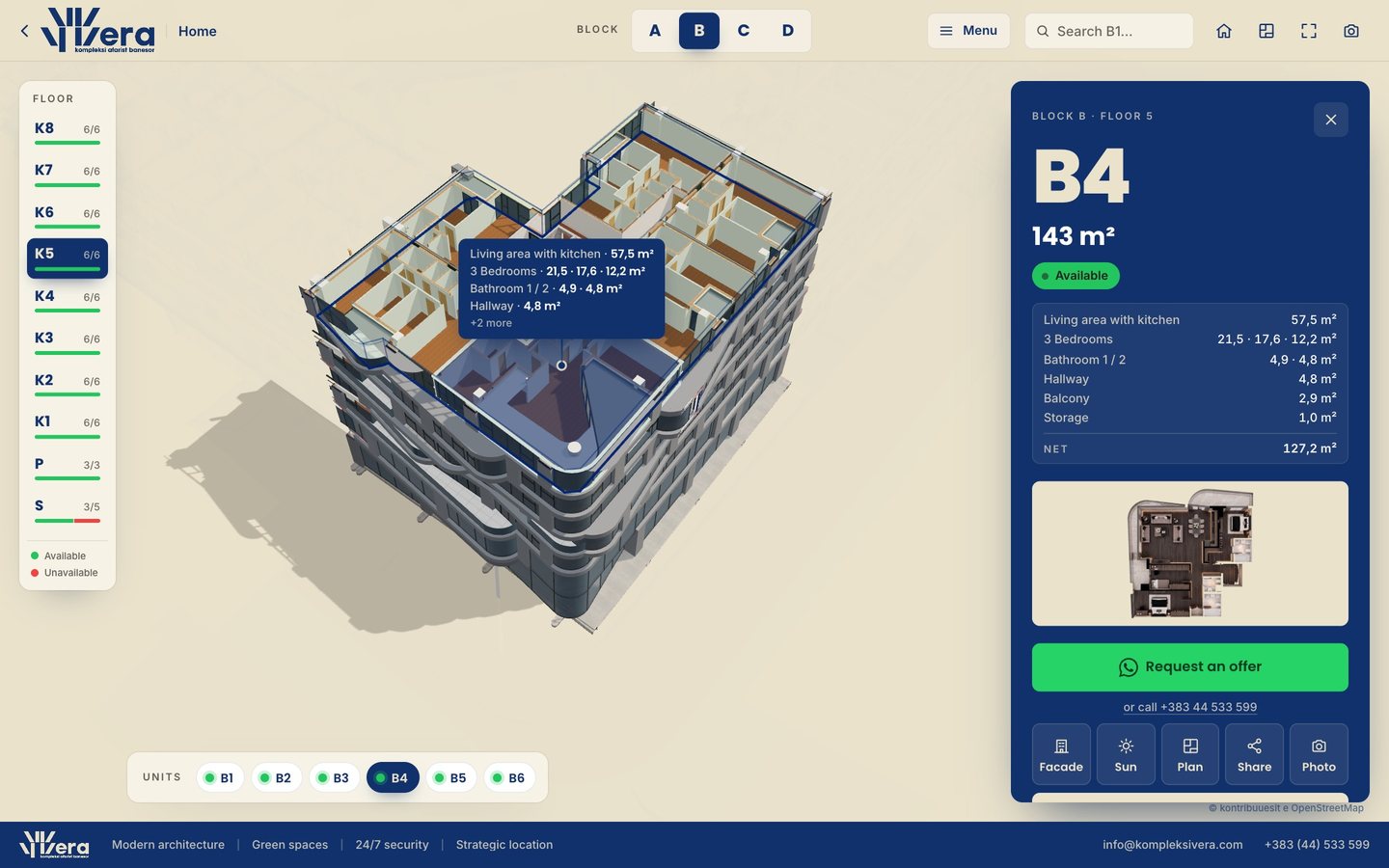
Kompleksi Vera is a new residential complex in the centre of Gjilan, Kosovo: four blocks of apartments over a ground floor of shops. What reached us was raw material — 252 architect plan sheets, floor drawings in PDF and a 3D model with no unit names in it. Brigada turned it into kompleksivera.com, where a buyer turns the building, opens a floor and sees their apartment.
The brief: sell homes from a set of drawings
Every unit is sold before it is finished, so the website has to show what does not exist yet. The material for it came straight from the architects: a plan sheet per apartment (216 of them, and 36 more for the shops), floor drawings for each block and floor as PDFs, and the architect's own 3D model, a 307 MB FBX file with 2.7 million triangles.
None of it was made for the web. The model did not know which room belonged to which apartment, the PDFs were print documents, and a plan sheet is a technical drawing, not something a buyer falls in love with.
From a raw model to a building you can open
We built a Blender pipeline that imports the architect's FBX, sorts it into blocks and floors, and compresses it with Draco and meshoptimizer for the browser, with a lighter version for phones. Each unit is then traced from its plan sheet onto its floor in 3D, calibrated sheet by sheet, so all 254 apartments and shops become volumes you can tap, coloured by whether they are still available.
The viewer runs on three.js. A buyer picks a block, a floor and a unit; the floors above lift away so the apartment can be seen in place, and a panel shows its area, its rooms and a button that opens an enquiry on WhatsApp.
A render of every unit, floor by floor
Layouts change between floors: the same apartment type is 151 m² on one floor and 121 m² on another, with different rooms. One picture per type would have been wrong for most buyers, so we built an AI-assisted image pipeline that turns each unit's own plan into a photoreal top-down interior, and each shop into a fitted-out commercial space.
The result is 247 units showing a render of their own floor, cut out and placed on the site, in the 3D panel and on every unit page — and checked by hand before anything went live.
A story first, then the live 3D
The homepage opens as a scroll story: the complex in its real neighbourhood, then one block, then its floors opening up, before the page hands the visitor the live 3D. On phones a sideways swipe turns the building and an up or down swipe keeps scrolling, so the 3D never traps the page.
Three languages, built to be found
The site is in Albanian, English and German, the languages of the local market and of the diaspora buying from abroad. Every unit has its own page in each language, with structured data, a sitemap entry and language alternates, and the public pages score 100 for SEO and accessibility in Lighthouse.
One app for the site and the sales team
The same Laravel 12 application runs the sales back office in Filament: when a unit is reserved or sold, the website and the 3D show it at once. The sales team's tools — PDF sales books and shareable unit links for agents — live in the same app, so there is one source of truth for every apartment.
Where it stands
The site is live at kompleksivera.com, with all four blocks on sale. Designed and built by Brigada, from the architect's raw files to the live 3D.
Kompleksi Vera — frequently asked
- What is Kompleksi Vera?
- Kompleksi Vera is a residential complex in the centre of Gjilan, Kosovo: four blocks of apartments over a ground floor of shops. Its website, kompleksivera.com, lets buyers explore the building in 3D and see every unit.
- Who built the Kompleksi Vera website?
- Brigada.dev designed and built it, from Prishtinë, Kosovo — the 3D building, the unit renders and the sales back office.
- How was the 3D building made?
- From the architect's own 3D model: imported and organised in Blender, compressed for the web with Draco, and every apartment and shop traced from its plan sheet onto its floor.
- What does the Kompleksi Vera site run on?
- Laravel 12 with a Filament v3 admin, three.js for the 3D, a Blender build pipeline for the model, and Vite.
- Web developmentLaravel sites and the admin behind them.
- Evergreen ValleysAnother Kosovo development: a bilingual digital showroom.
- All case studiesEvery product we have shipped, in one place.